
Making the Most of the Micro: What the 1980s Taught me About AI
Making the most of the micro
Like many a middle-aged man once the wife and kids have gone to sleep, I suspect I am not alone in succumbing to temptation now and again, in that I allow myself to fall down the rabbit hole of nostalgia. A recent excursion into the past had me contemplating how AI is coming for our jobs and our way of life.
The BBC Micro educating the country
In the early 1980s the BBC decided that the country needed to understand computers, and then did something about it that I suspect no institution would attempt today. The ambitious Computer Literacy Project launched in 1982 and encompassed television, schools, printed material and, remarkably, a specification for a machine. Acorn won the contract and the result was the BBC Micro, near ubiquitous in the utilitarian classrooms of Thatcher's Britain. Acorn's processor work would later give rise to Arm, the architecture now sitting inside billions of devices, which is a fairly respectable return on a public broadcaster's side project.
The first accompanying television series was The Computer Programme, which opened memorably with Kraftwerk's Computer World, and in 1983 it was followed by Making the Most of the Micro. The intention was never to turn the nation into programmers. It was to help ordinary people understand what these machines were becoming capable of doing.
Make it stand out
The BBC Computer Literacy Project is still online at: BBC Computer Literacy Project Archive
My tech journey from 1987 to today
Pioneer times indeed. The power and mystery of home computing became accessible to the masses, and Tripyear HQ was no exception as from 1987 a Sinclair ZX Spectrum +2 graced our living room carpet. Games were the order of the day, and copied cassettes strewn across the living space near obscured the pattern of the 1970s faux-Axminster. This state of affairs continued until my father, observing me careering round on a dirt bike on Enduro Racer, delivered the rebuke that still rings in my ears: "I didn't get you that computer so you could play games on it all day."
Thus was born in me the same desire as many others at the time, to see what this grey box of wires could actually do. The Spectrum was pressed into service for a variety of tasks, among them a database to look up telephone area codes and a tracker for collecting Green Shield stamps. My crowning achievement was a BASIC program to calculate the height of a large tree using a tape measure and a set square. It was subsequently ported to the school's BBC Model B and saved on 5¼ inch floppy. I can therefore take credit for St Gabriel's in Blackburn being able to record accurately the heights of trees on its property throughout the late 1980s. You're welcome.
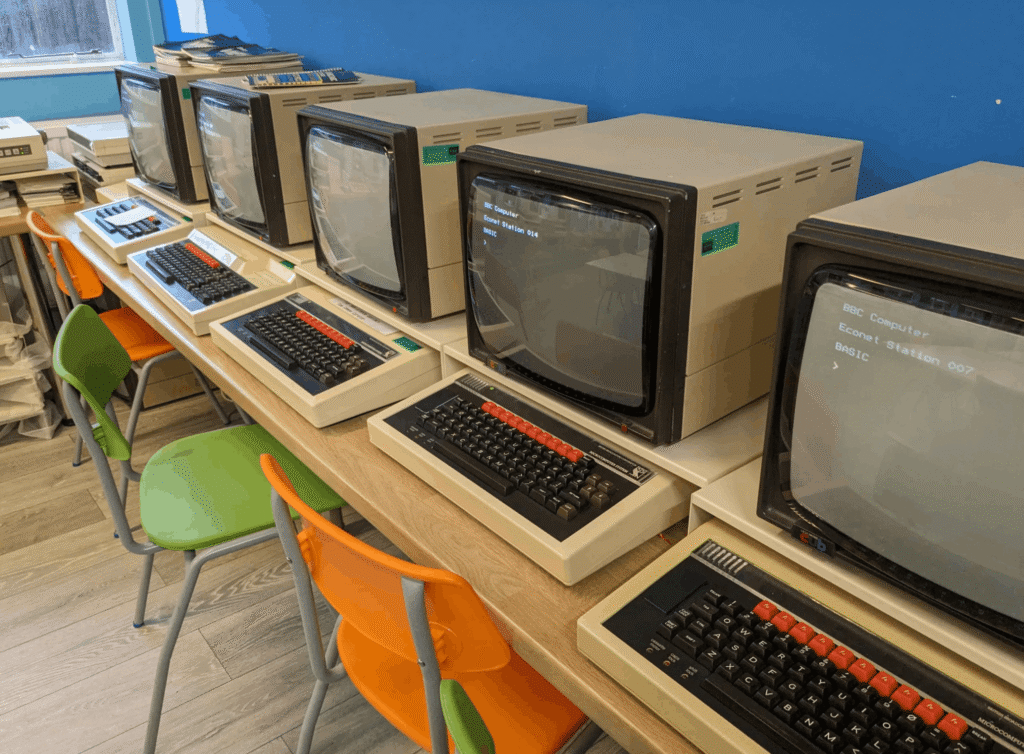
Image courtesy of raspberrypi
What “Mac” was actually showing us
The series played a key role in all this, although by the time I saw it broadcast on early weekend mornings as part of BBC Two's Open University output it was already outdated. It was in the small hours recently that I re-watched it on YouTube and relived how the mellifluous Ian McNaught-Davis (Mac) took us on a voyage of discovery, demonstrating how the ordinary machines in our living rooms could help us run a business, animate a sequence and even access information on the other side of the world. One striking demonstration saw him use a primitive modem to link his BBC Model B to a newspaper archive in the United States, which he then searched remotely for American coverage of computer education. Impressive stuff for 1983.
He showed the owner of a family chain of bakeries using VisiCalc to plan production. Another episode demonstrated the BBC's own database of gramophone records, searched to locate rare music that radio listeners had requested. Watching these more than forty years later, what strikes me is how mundane their descendants became. Spreadsheets and searchable databases stopped being computer “packages” and simply became part of work.
However, there is more in the bakery than a man doing sums faster, and it took my sleep-addled brain a while to appreciate it.
The spreadsheet did not merely speed up the calculation. It made recalculation cheap. Change an assumption and run it again, change the production volume and run it again, and again, at almost no cost. Our baker could suddenly afford to think about his business in ways that had simply never been worth the effort before. VisiCalc did not change the speed of the work so much as the amount of thinking it was economical to do.
That, I suspect, is what is happening to knowledge work right now. Which means the interesting question is not how AI makes an existing task faster. It is what has just become cheap that used to be expensive. Analysis nobody would have commissioned. Software for problems too small to justify hiring a developer. Twelve scenarios where we used to model three. Bespoke work that previously only the largest customers could be given economically.
Access to data and analysis is where I see this most clearly today. My work takes me behind the curtain of a fair number of businesses, and the common thread among the ones getting real value from AI is not that they write better prompts. Generally, it is that the “thing” is wired into their own data and lives inside the systems they already use, close enough to the work that it functions as a colleague rather than a tool. Someone who can be interrogated and who answers the questions that were never quite worth the effort of asking, which is precisely what our 1980s baker discovered about VisiCalc. The businesses getting very little out of it are almost always the ones holding it at arm's length in a separate browser tab, cut off from anything that would let it know what they actually do.
Haven't we had this argument before?
At around the same time, there were serious debates in education about the pocket calculator. Critics argued that calculators hindered the development of any true understanding of maths and amounted to a shortcut. Others argued that they opened up new fields of understanding by removing the drudgery.
I would like to tell you that we settled that argument, but I am not sure we did. I certainly cannot pretend that my mental arithmetic, or my ability to use a slide rule, compares with that of my grandparents. On the other hand, cheap computation via calculator has let me undertake analysis that would have been impractical for them. Both sides were partly right, which is the least satisfying and most likely answer, and I suspect the same will be said of AI in thirty years by someone who has forgotten how to do something I still consider basic.
So what should AI literacy actually mean?
Here is my point. AI literacy should mean what computer literacy meant in 1983. Not how the model works, since anyone can type a prompt, but what it can do, where it fails and, crucially, how you would know.
That last part is where the analogy strains almost to breaking point: If AI is a colleague, it is a junior one. A BBC Micro did nothing until you told it to,, and when my BASIC went wrong it brought the program to its knees. An error message, a blank screen, or a tree that was apparently four hundred feet tall. The machine's failure was the beginning of my real education, because I had to work out why. AI is different. It produces confident, articulate and entirely plausible output whether or not you understand the subject, and whether or not it is right. It has never been easier to use amazing technology and look totally incompetent. It is remarkably good at finding the gaps in the understanding of anyone who leans on it too heavily… and then magnifying them.
So curiosity is no longer sufficient. It has to be accompanied by judgement, which is an uncomfortable thing to say in an industry currently selling the opposite.
Nobody is making the programme
This is the part that bugs me the most. In 1982 a public institution decided the nation needed to understand a new technology, and commissioned a machine, a curriculum and a television series to make it happen, delivering high quality output to millions of people and changing the lives of many. Whatever you think of the BBC, the ambition was extraordinary and the execution was largely successful. An eleven year old in Blackburn ended up measuring trees because of it, and later went on to spend a long career in technology.
Nothing remotely equivalent exists for AI. What we have instead is vendor marketing, conference keynotes and LinkedIn posts, which is to say we are being educated almost entirely by people with something to sell. I include myself in that, and you should read the preceding fifteen hundred words with it in mind.
They took our jobs
There was a very real fear in the 80s that computers would steal our jobs and render us ignorant, and it would be impossible to argue that this did not happen to some degree. My own uncle was a time-served design draughtsman, a skilled man with years of experience behind him. He didn't keep up with the times and he lost his job "to a computer". Telling him that computerisation would eventually create millions of new roles would have been no consolation whatsoever, because the skill on which he had built his livelihood was the one being computerised.
I have done OK out of the same disruption that finished his career. Every single role I have moved into since my first job out of university in 2002 is one that did not exist before I occupied it. Both of those things are true and neither cancels out the other, and I have never found a tidy way to hold them together. I expect AI to be no less disruptive, and no more evenly distributed in who it rewards.
I have no doubt that we will one day look back on the present with the same smiling eyes and knowing grin with which I watched Mac explain the "Winchester", or a hard drive to those of you born after 1990. Typing prompts into ChatGPT to make a meme or “find a decent sushi restaurant in Middlesbrough” will look every bit as quaint.
Nearly forty years on, my father's advice still holds. Don't just spend all day playing with the new technology. Find out what the grey box can actually do.
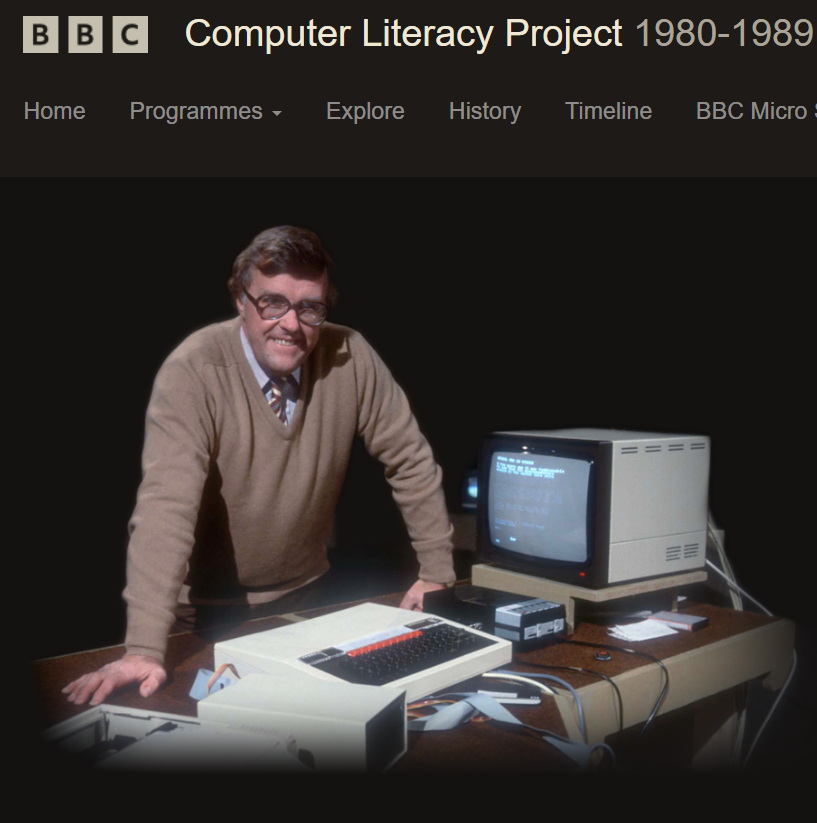
Image courtesy of the BBC.
*For anyone interested, the BBC has an excellent online archive of the Computer Literacy Project that can be found here: BBC Computer Literacy Project Archive